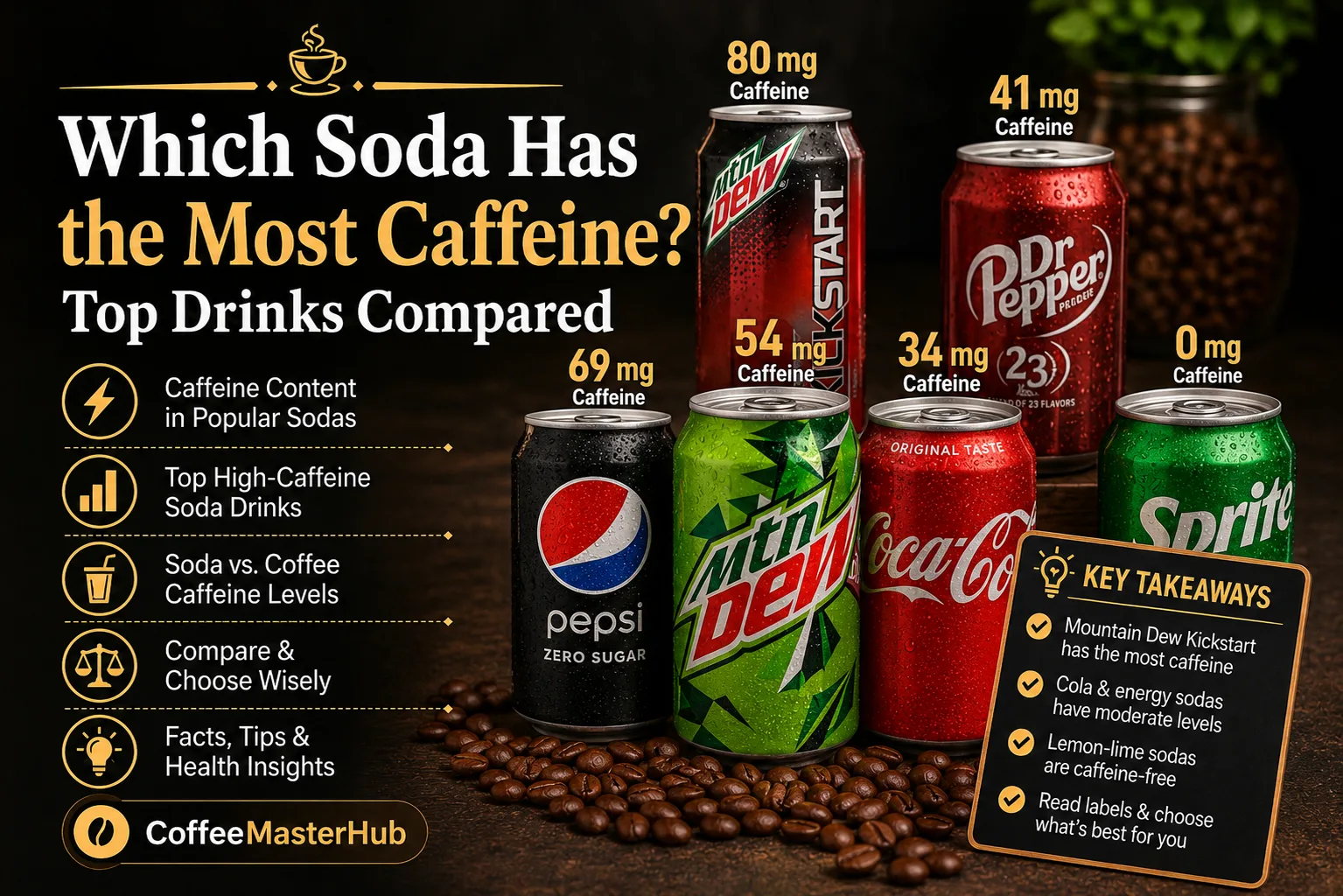
A soda’s caffeine content depends on the formula, not the flavor or the logo. Most sodas contain far less caffeine than a cup of coffee, but the gap between brands is wider than many people expect.
Among widely sold brands, Mountain Dew sits at the top of the regular lineup. Colas fall lower, and several popular sodas contain none. Here is how the main options compare.
Soda Caffeine Chart: Popular Drinks Compared
The table below lists commonly reported caffeine amounts for a 12-ounce (355 ml) can. Treat the numbers as close estimates, because formulas change and sources differ slightly.
| Drink | Caffeine (approx.) | Category |
|---|---|---|
| Sun Drop | 64 mg | Citrus |
| Mountain Dew (regular and diet) | 54 mg | Citrus |
| Mello Yello | 51 mg | Citrus |
| Diet Coke | 46 mg | Cola |
| Dr Pepper | 41–42 mg | Pepper-style |
| Pepsi | 38 mg | Cola |
| Diet Pepsi | 35 mg | Cola |
| Coca-Cola Classic | 34 mg | Cola |
| Coca-Cola Zero Sugar | 34 mg | Cola |
| Barq’s Root Beer | 22 mg | Root beer |
| Sprite, 7UP, Fanta, ginger ale | 0 mg | Clear or fruit-flavored |
The Short Answer: Mountain Dew Leads the Mainstream Brands
Mountain Dew, diet or regular, lists about 54 mg per 12 oz, which puts it ahead of most nationally distributed sodas. Regional favorite SunDrop measured around 65 mg in lab testing, so it edges out Mountain Dew where it is sold.
Some Zero Sugar versions complicate the ranking. PepsiCo-based figures list Mtn Dew Zero Sugar at 69 mg per 12 oz, while other sources report 54 mg.
Pepsi Zero Sugar is similarly inconsistent. Some sources list it at 69 mg, but another reports it dropped to 38 mg after a 2023 reformulation. I could not confirm which figure is current for every market, so check the manufacturer’s product page for the exact can you are buying.
Older high-caffeine colas such as Jolt are largely out of the picture. Jolt Cola was reported at 72 mg but is no longer available.
Why Diet and Zero Sugar Sodas Often Have More Caffeine
Diet Coke is a good example. It has about 46 mg of caffeine, compared with about 34 mg in regular Coke.
The sweetener type does not set the caffeine amount. Each brand chooses the level for each product, so there is no universal rule. Never assume a diet version matches its sugary counterpart.
Colas Versus Citrus Sodas: What the Pattern Shows
Dark colas tend to cluster between 34 and 46 mg. Citrus sodas like Mountain Dew and Mello Yello run higher, at roughly 51–54 mg.
Clear sodas are usually caffeine-free. Sprite, 7UP, and Fanta contain none, and most ginger ales are also free of it.
Root beer varies. Barq’s contains some caffeine, while many other root beers contain none, so read the label.
Soda Versus Coffee: How Big Is the Gap?
A can of soda is a mild caffeine source compared with coffee. Brewed coffee generally delivers about two to three times the caffeine of a cola in a smaller serving.
| Drink | Serving | Typical caffeine |
|---|---|---|
| Mountain Dew | 12 oz | ~54 mg |
| Diet Coke | 12 oz | ~46 mg |
| Coca-Cola Classic | 12 oz | ~34 mg |
| Brewed coffee | 8 oz | ~80–100 mg |
| Espresso (single shot) | ~1 oz | ~60–75 mg |
| Brewed green tea | 8 oz | ~25–30 mg |
Coffee numbers vary more than soda numbers because the cup is not standardized. Bean species, brew ratio, grind size, and extraction all affect the result. Robusta beans, for example, contain roughly twice the caffeine of Arabica.
Soda is the opposite. Its caffeine is added at a fixed level, so a can is far more predictable than a cup.
Serving Size Changes the Math
The figures above are for 12 oz cans. Bottles and fountain cups can multiply the total quickly, because caffeine scales with volume.
- A 20 oz bottle of Mountain Dew contains about 90 mg.
- A 20 oz bottle of Coca-Cola Classic contains about 57 mg.
- A 32 oz fountain Mountain Dew can reach roughly 144 mg.
That last drink lands close to a strong cup of brewed coffee. If you sip a large soda through the afternoon, the total adds up even though each swallow feels mild.
How Much Caffeine Is Too Much?
The FDA identifies about 400 mg per day as an amount not generally associated with negative effects for most healthy adults. That is roughly seven 12 oz cans of Mountain Dew, though soda is rarely your only source.
Sensitivity varies a lot. Pregnancy, certain medications, and heart or sleep concerns can all change what is appropriate. If any of these apply to you, ask your doctor rather than relying on a general guideline.
Tips for Checking the Caffeine in Your Soda
Soda cans do not always list the caffeine amount. These habits help you stay informed:
- Check the manufacturer’s product page. Brands publish caffeine content for most products.
- Compare by volume. Judge the 12 oz figure, not the bottle, to compare fairly.
- Watch new flavors and limited editions. Variants can differ from the original product.
- Look for “caffeine free” labels. Many brands offer caffeine-free versions of their colas.
Conclusion
If you want the most caffeine from a mainstream soda, look at Mountain Dew first, then regional options like Sun Drop. Colas are milder, and Sprite, 7UP, and Fanta contain none.
Whatever you choose, remember that coffee still delivers more caffeine per serving. For a bigger lift, a cup of brewed coffee or an espresso does more than any single can. For a gentler option, a cola or a caffeine-free soda fits better.
FAQs
Does Coke or Pepsi have more caffeine?
Pepsi has slightly more, at about 38 mg per 12 oz compared with about 34 mg in Coca-Cola Classic. The difference is small.
Does Sprite have caffeine?
No. Sprite, 7UP, and Fanta are caffeine-free, which makes them easy choices if you want to avoid caffeine altogether.
Is there more caffeine in soda or coffee?
Coffee usually has more. An 8 oz cup of brewed coffee typically contains about 80–100 mg, while most sodas contain 34–54 mg per 12 oz.