
Quick Answer
To Brew Ethiopian Coffee, use freshly ground beans, clean filtered water, and a brewing method like pour-over, French press, or traditional jebena. Maintain a coffee-to-water ratio of 1:15 to 1:17 and brew with water between 90°C and 96°C to preserve its fruity and floral flavors.
Introduction
Most people ruin Ethiopian coffee by brewing it like regular coffee. That’s why it often tastes flat, bitter, or just average. Ethiopian coffee is different. It’s known for its bright acidity, floral aroma, and natural sweetness. But these qualities only come out when you use the right method, grind size, and temperature.If you get even one of these wrong, you lose the entire experience.
In this guide, you’ll learn exactly how to brew Ethiopian coffee step by step with practical tips for a perfect cup every time.

What Makes Ethiopian Coffee Unique?
Ethiopia is the birthplace of coffee, and its beans are very different from regular coffee beans.
Key characteristics:
- Light to medium roast
- Regions: Yirgacheffe, Sidamo
- Processing: Washed or natural
Flavor notes:
- Berries
- Citrus
- Peach
- Tea-like notes
Because of these delicate traits, brewing method matters more than usual.
Best Grind Size for Ethiopian Coffee
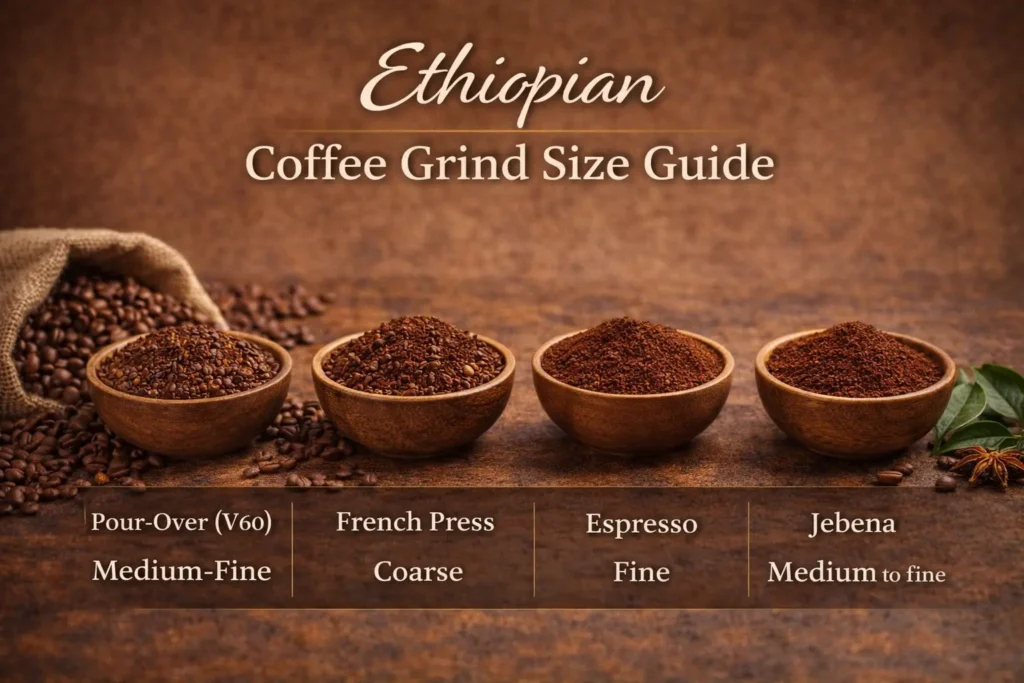
Grind size directly controls extraction.
Use the right grind for each method:
- Pour-over (V60): Medium-fine
- French press: Coarse
- Espresso: Fine
- Jebena: Medium to fine
Important tip:
- Always use freshly ground coffee
- Pre-ground coffee loses aroma quickly
Ideal Coffee-to-Water Ratio
A proper ratio ensures balanced flavor.
Recommended ratio:
- 1:15 → Strong coffee
- 1:17 → Light coffee
Example:
- 15g coffee + 225ml water
Consistency is key. Once you find your perfect ratio, stick to it.
Perfect Water Temperature
Water temperature is often ignored but very important.
Ideal range:
- 90°C to 96°C
Without thermometer:
- Boil water
- Let it sit for 30–45 seconds
This simple step improves taste significantly.
Method 1: Pour-Over (Best for Flavor Clarity)

Steps:
- Place filter in dripper
- Rinse with hot water
- Add medium-fine coffee
- Pour small water (bloom)
- Wait 30–40 seconds
- Slowly pour remaining water in circles
Result:
- Clean cup
- Strong floral & fruity notes
Method 2: French Press (Full Body Flavor)
Steps:
- Add coarse coffee
- Pour hot water
- Stir gently
- Steep for 4 minutes
- Press slowly
Result:
- Heavy body
- Strong taste
- Less clarity in flavors
Method 3: Traditional Ethiopian Jebena

Steps:
- Add finely ground coffee to water
- Heat in jebena (clay pot)
- Bring close to boiling
- Remove and let grounds settle
- Pour into small cups
Result:
- Bold flavor
- Slight smoky taste
- Authentic experience
Pro Tips to Brew Ethiopian Coffee Perfectly
- Use fresh beans (2–3 weeks after roast)
- Always use filtered water
- Control brew time carefully
- Never skip the blooming step
- Pour slowly (don’t rush)
Common Mistakes to Avoid
- Using boiling water
- Wrong grind size
- Over-extraction → bitter taste
- Under-extraction → sour/weak coffee
- Rushing the process
How Brewing Method Changes Flavor
Different methods give completely different results:
- Pour-over: Bright + clean
- French press: Strong + heavy
- Jebena: Bold + traditional
Experiment to find what suits your taste.
Best Brewing Method for Ethiopian Coffee
There’s no single best method.
Choose based on preference:
- Clean & balanced → Pour-over
- Strong & rich → French press
- Traditional experience → Jebena
Beginner recommendation:
Start with pour-over for best results.
Conclusion
Brewing Ethiopian coffee is all about precision and patience. When you use the right grind size, correct ratio, and proper temperature, you unlock its true flavors fruity, floral, and naturally sweet. Small changes make a big difference. So take your time, experiment, and enjoy the process.
About the Author
Muhammad Hammad Abbas is the founder of Coffee Master Hub, where he shares practical coffee guides and brewing tips based on hands-on experience and research. He focuses on simplifying coffee knowledge and testing different methods to help readers make better coffee at home.
FAQ’S (Frequently Asked Questions)
Pour-over is considered the best method because it highlights fruity and floral flavors.
It’s not necessarily strong in caffeine, but it has a bold and complex flavor.
Yes, but it may not bring out the full flavor compared to manual methods.
This comes from the beans’ origin and processing method, especially natural processing.